
Industry Solutions · Enterprise SMS · 27 October 2026 · Harender Chaudhary · ~6 min read
Enterprise Messaging Architecture: SMPP vs. REST SMS API for High-Volume Routing and Scalable Delivery
Choosing between SMPP and REST SMS APIs impacts throughput, latency, and operational cost at enterprise scale. Learn how to architect high-volume messaging pipelines, manage carrier sessions, and optimize message routing for global delivery.
View Enterprise SMS product →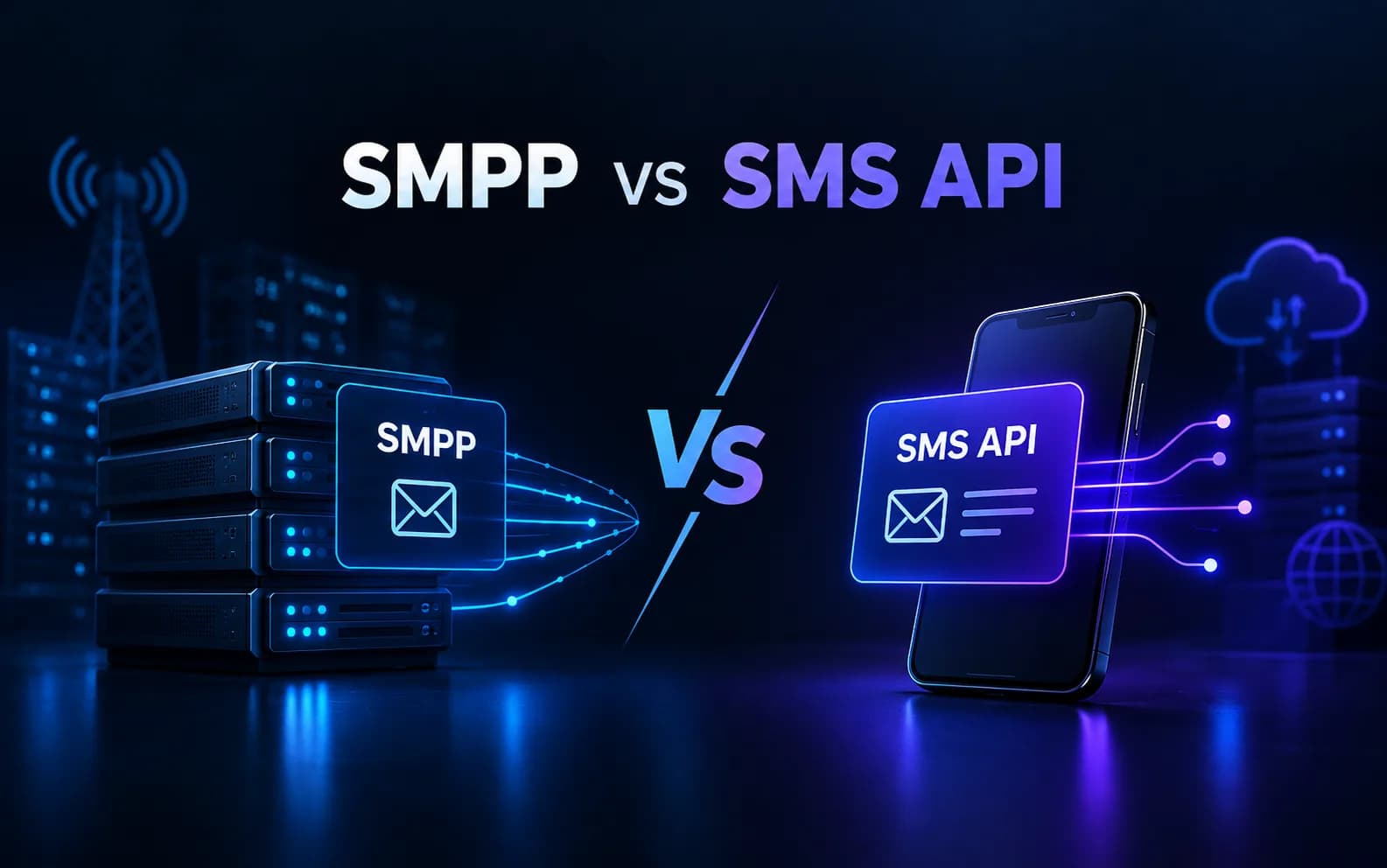
The Enterprise Messaging Conundrum
At enterprise scale, message delivery is an engineering challenge governed by throughput constraints, network latencies, carrier routing complexities, and protocol overhead. Whether delivering multi-factor authentication (MFA) passcodes, transaction notifications, or high-volume marketing campaigns, selecting the underlying communication layer dictates your platform's reliability, latency, and operational cost.
Developers and enterprise architects typically weigh two primary options: Short Message Peer-to-Peer (SMPP) protocol and modern RESTful SMS APIs.
While REST APIs simplify integration for web and mobile applications, high-throughput environments often require the raw performance and low-level control of SMPP. Understanding the trade-offs between these messaging mechanisms is critical for building resilient telecommunication infrastructure.
Understanding SMPP (Short Message Peer-to-Peer)
SMPP (Short Message Peer-to-Peer)is an open, industry-standard telecommunications protocol designed for exchanging SMS messages between Short Message Service Centers (SMSCs) and External Short Messaging Entities (ESMEs). Operating at the Application Layer over TCP/IP, SMPP provides a persistent, asynchronous, bi-directional pipe built specifically for high-volume telecommunication workloads.

Key SMPP Characteristics
- Persistent Sessions: Establishes long-lived TCP connections (
bind_transceiver,bind_transmitter, orbind_receiver), avoiding the overhead of repeated TCP handshakes and TLS negotiations per message. - Protocol Data Units (PDUs): Encapsulates commands and responses in lightweight binary PDUs (such as
submit_sm,deliver_sm, andsubmit_sm_resp), minimizing payload size. - Asynchronous Execution: Supports windowing, allowing an ESME to transmit multiple request PDUs without waiting for individual acknowledgments, maximizing bandwidth utilization.
- Carrier-Grade Routing: Provides direct interaction with mobile network operator (MNO) infrastructure, enabling granular control over routing, system IDs, and data coding schemes (DCS).
Understanding RESTful SMS APIs
RESTful SMS APIs abstract telecommunication protocols behind HTTP/HTTPS interfaces. Representational State Transfer (REST) APIs expose endpoints that convert JSON or XML payloads into telecom-compatible operations, handled by an intermediary API gateway or CPaaS provider.

Key REST SMS API Characteristics
- Stateless Communication: Employs stateless HTTP client-server interaction. Every request carries full authentication credentials (e.g., Bearer Tokens, API Keys).
- Developer Ergonomics: Integrates cleanly into modern software stacks using standard HTTP client libraries across Node.js, Python, Java, Go, and C#.
- Abstracted Infrastructure: Handles carrier session management, PDU encoding, character set conversions (GSM 7-bit vs. UCS-2), and failover routing under the hood.
- Webhooks for Asynchronous Events: Relies on HTTP callbacks (webhooks) to inform client systems of delivery receipts (DLRs) and inbound messages.
SMPP vs. REST SMS API: Core Architectural Comparison
Architectural Dimension | SMPP Protocol | REST SMS API |
Transport Layer | Persistent TCP/IP | HTTP/1.1 or HTTP/2 over TLS |
Data Format | Binary PDUs | JSON / XML over HTTP |
Connection Overhead | Minimal after initial session bind | High (TCP + TLS handshake per batch or request) |
Throughput (TPS) | Extremely High ($100$ to $1,000+$ TPS per bind) | Moderate to High ($10$ to $200$ TPS, rate-limited by gateway) |
Latency | Ultra-Low ($< 50\text{ ms}$ transport time) | Moderate ($100\text{ ms} - 500\text{ ms}$ gateway overhead) |
Integration Complexity | High (Requires PDU management, bind maintenance) | Low (Standard REST endpoints and HTTP methods) |
Connection Model | Asynchronous, full-duplex session | Request-Response (or HTTP/2 Multiplexing) |
Delivery Receipts | Native | Webhooks (HTTP callbacks to public endpoints) |
Deep-Dive Technical Evaluation
1. Session Management & Network Overhead
SMPP maintains a persistent connection. Once bound, sending an SMS requires transmitting only a few hundred bytes of binary PDU over an established TCP stream.
Conversely, REST APIs send HTTP headers, JSON payloads, and authentication tokens over HTTPS. Even with connection pooling and HTTP keep-alives, the transport overhead of REST APIs remains significantly higher than native SMPP binary frames.
2. Throughput and Windowing
To achieve high Messages Per Second (MPS) or Transactions Per Second (TPS), SMPP uses windowing.
The window size defines how many submit_sm PDUs an ESME can send before requiring a submit_sm_resp from the SMSC. If the window size is set to $50$, the application can transmit $50$ messages asynchronously into the TCP socket without blocking execution, optimizing throughput over high-latency network links.
REST APIs achieve scale primarily via horizontal worker scaling and HTTP batch endpoints (sending arrays of messages in a single HTTP POST). However, processing HTTP headers, parsing JSON arrays, and executing gateway-level authorization at high volumes adds computational overhead compared to direct binary parsing.
3. Delivery Receipt (DLR) Handling
- SMPP DLRs: Delivery status report updates are pushed directly by the SMSC to the client ESME over the active TCP session via
deliver_smordata_smPDUs. This eliminates the need for inbound public firewall openings or HTTP listener servers. - API DLRs: The CPaaS provider converts SMSC status reports into an HTTP POST request targeted at an application webhook URL. This setup requires maintaining public endpoints capable of handling high-volume callback spikes without throttling.
Routing & Deliverability in Enterprise Messaging
Achieving global delivery requires dynamic routing architectures. Mobile network operators frequently update network prefixes, port numbers (via Local Number Portability or LNP), and spam filtering rules.

Key Routing Strategies
- Least-Cost Routing (LCR): Message engines evaluate destination country codes and mobile network codes (MCC/MNC) to select the lowest-cost direct link or aggregator route.
- Dynamic Failover & Redundancy: If an SMPP bind experiences an unexpected unbind (
unbindPDU) or elevated latency, traffic automatically reroutes to a secondary SMPP bind or a failover REST API endpoint. - Adaptive Rate Limiting: Carriers enforce strict TPS limits per bind (e.g., $50\text{ TPS}$). An enterprise routing engine must implement token-bucket or leaky-bucket algorithms to queue messages, preventing carrier drop errors (
ESME_RTHROTTLED).
Decision Matrix: When to Implement Which Protocol
Choose SMPP If:
- You are connecting directly to Mobile Network Operators (MNOs) or tier-1 messaging hubs.
- Your application processes millions of messages per day or requires continuous throughput exceeding $200\text{ TPS}$.
- You require ultra-low latency delivery for time-critical workloads like time-based One-Time Passwords (OTPs).
- You possess in-house engineering expertise to handle custom socket connections, binary framing, thread management, and automated bind reconnect loops.
Choose REST SMS API If:
- You need rapid integration and fast time-to-market using standard application stacks.
- Your throughput requirements are low to moderate (under $100\text{ TPS}$).
- You rely on a CPaaS vendor to manage carrier relationships, global dynamic routing, compliance, and regulatory submissions (e.g., A2P 10DLC, DLT registration).
- You prioritize lower infrastructure maintenance over direct network protocol control.
Modern Hybrid Architectures: The Best of Both Worlds
To balance development speed with high-performance throughput, modern enterprise platforms often adopt a Hybrid Messaging Architecture.
In this pattern, internal microservices communicate with an internal API Gateway via REST, gRPC, or AMQP queues (such as RabbitMQ or Apache Kafka).
The internal gateway then routes messages to an SMPP Session Pool Manager, which maintains persistent binds to multiple global tier-1 carriers.

Benefits of the Hybrid Approach:
- Separation of Concerns: Business applications consume clean REST/gRPC interfaces without needing to manage socket-level SMPP state.
- Centralized Queuing & Throttle Control: The message gateway manages session pooling, keep-alives (
enquire_linkPDUs), rate limiting, and network failover transparently. - Scalable Infrastructure: Application teams can scale outward without multiplying the number of active carrier binds, avoiding carrier connection limits.
By aligning protocol selection with specific throughput requirements and operational constraints, software teams can engineer scalable, resilient messaging systems capable of handling enterprise-grade traffic worldwide.
Written by

Harender Chaudhary
CPaaS Content Strategist at Azmarq
Harender Choudhary is a digital marketing and customer communication strategist with extensive experience in SEO, performance marketing, digital growth, and technology-led customer engagement. His areas of expertise include CPaaS, WhatsApp Business, conversational communication, SMS, RCS, automation, and omnichannel customer engagement. He focuses on simplifying complex digital communication technologies and exploring how businesses can use automation, messaging platforms, and data-driven marketing strategies to improve customer engagement, generate leads, and drive sustainable business growth.
Related articles

Best WhatsApp Automation Platform for E-commerce: How to Double Conversions and Scale Effortlessly
Looking to scale your E-commerce brand? Learn how leveraging WhatsApp automation—from automated order updates to AI-driven customer support—can boost your ROI, reduce RTOs, and transform your customer journey.
Introducing Azmarq Omni SDK: Unifying SMS, WhatsApp, RCS, and OTP for Business Messaging
The new Azmarq Omni SDK unifies SMS, WhatsApp, RCS, and OTP into a single client library across 7 programming languages. Built for speed and reliability, it cuts integration time from weeks to hours so businesses can launch multi-channel customer communication effortlessly.
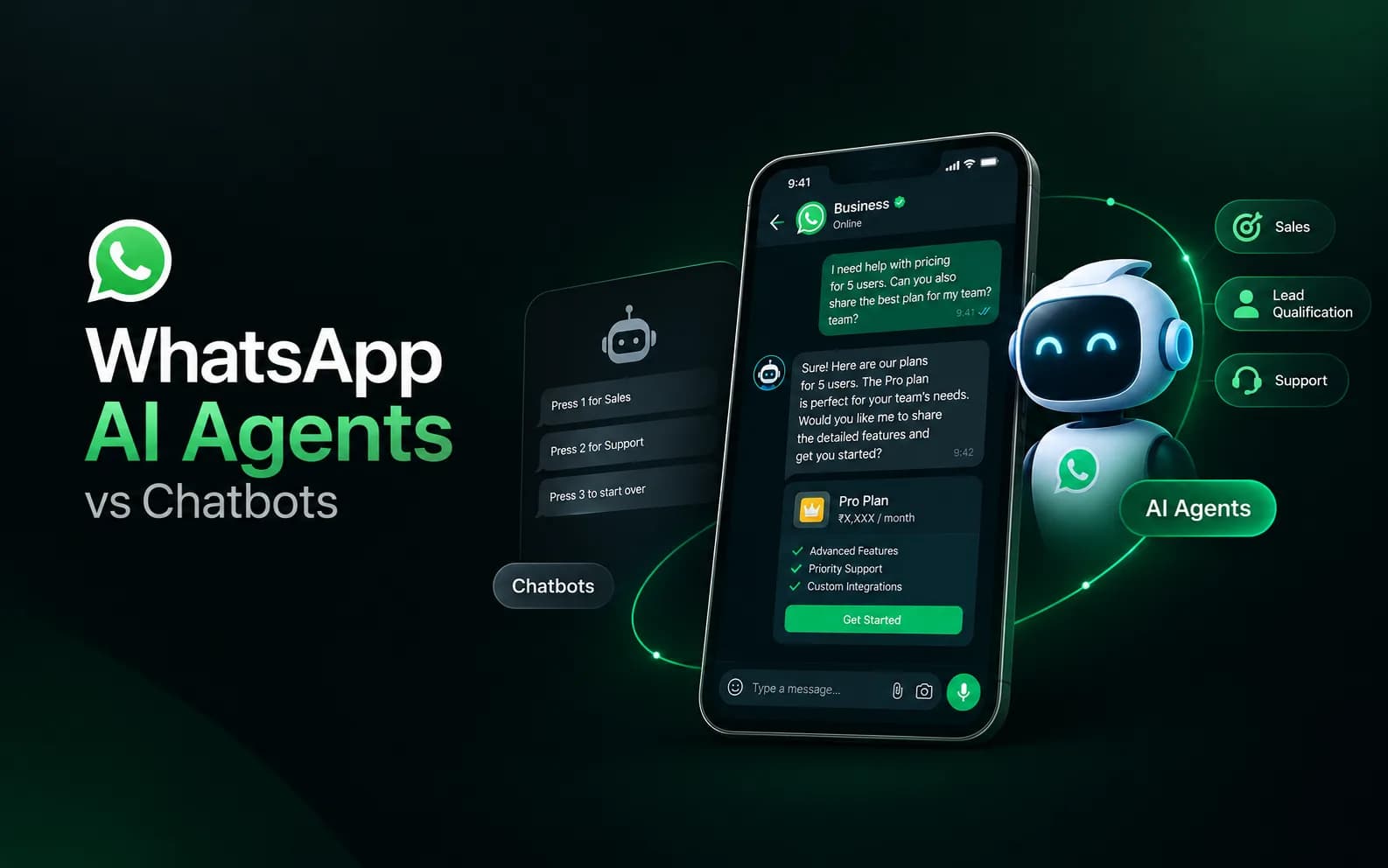
WhatsApp AI Agents vs Chatbots: What Should Your Business Use for Sales, Support & Lead Qualification?
Traditional rule-based chatbots often fall short when dealing with dynamic customer queries. Discover how context-aware AI agents on WhatsApp outperform traditional bots in lead qualification, sales conversion, and multi-channel support.
