
WhatsApp & Conversational Marketing · AI Agent Studio · 21 October 2026 · Harender Chaudhary · ~6 min read
WhatsApp AI Agents vs Chatbots: What Should Your Business Use for Sales, Support & Lead Qualification?
Traditional rule-based chatbots often fall short when dealing with dynamic customer queries. Discover how context-aware AI agents on WhatsApp outperform traditional bots in lead qualification, sales conversion, and multi-channel support.
View AI Agent Studio product →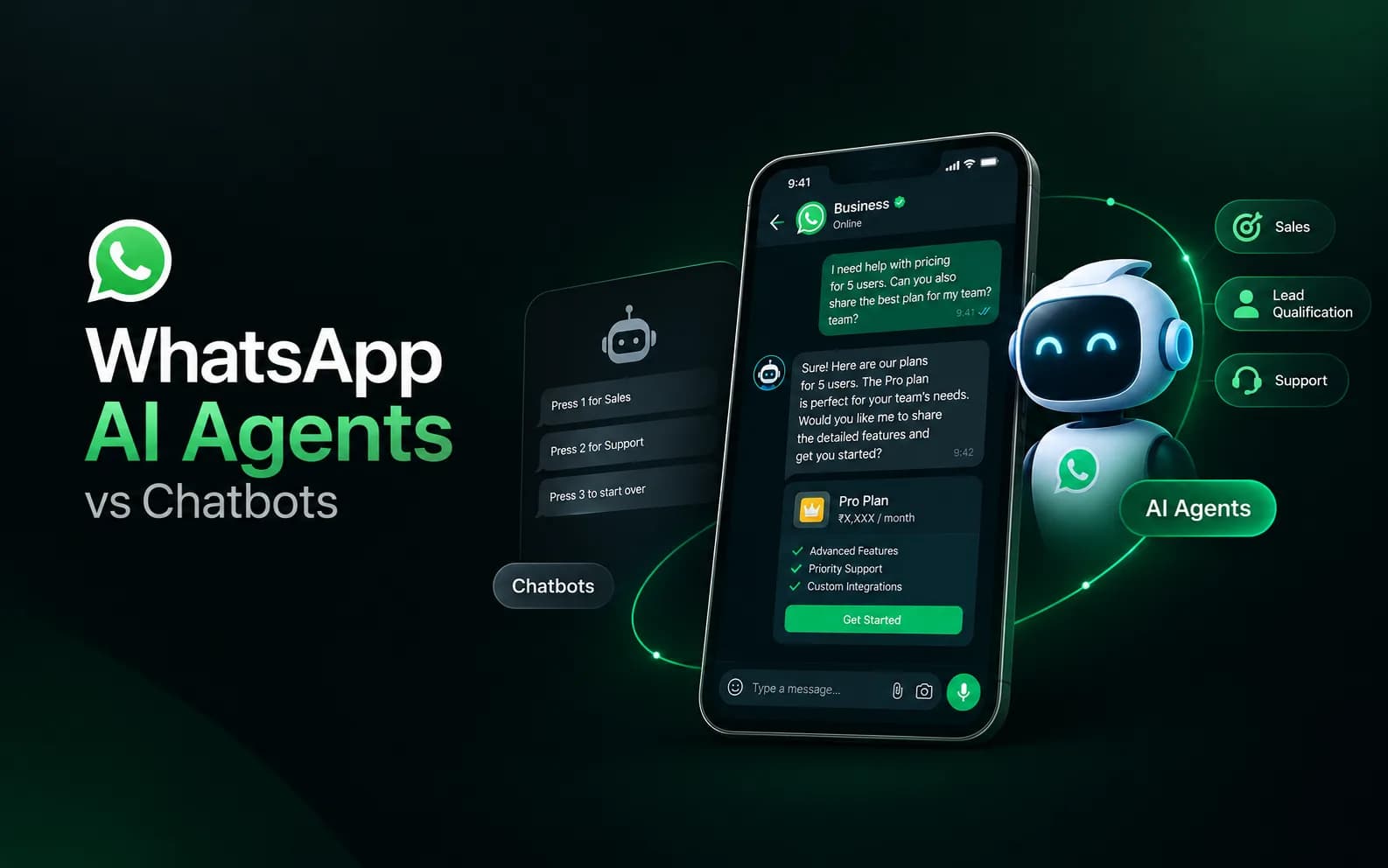
Every morning, thousands of businesses turn on Meta Click-to-WhatsApp ads with a clear goal, generate high-intent leads and drive fast sales conversions. Yet, an overwhelming majority of these prospects hit a wall the moment they send that initial message.
They ask a simple product question, only to get trapped in an endless loop of static button choices: Press 1 for Sales. Press 2 for Support. Press 3 to start over.
By the time a human agent picks up the ticket, the lead has already cooled off or moved to a competitor.
As modern conversational platforms mature, a fundamental shift is happening. The debate is no longer about whether you should automate customer conversations on WhatsApp, it is about how you automate them. Should you rely on traditional, rule-based chatbots, or is it time to upgrade to contextual, autonomous WhatsApp AI Agents?
Let us look closely at how these two technologies function under the hood, where each excels, and which approach delivers the highest ROI for your business goals.
The Core Difference: Rule-Based Logic vs. Contextual Understanding
To choose the right approach, you need to understand the structural difference between a chatbot and an AI agent.

Traditional WhatsApp Chatbots
Standard chatbots follow pre-scripted decision trees and strict keyword matching. They rely on "if-this-then-that" logic.
- How they work: If a user types "Pricing," the bot sends a pre-formatted template or text block. If the user types "How much does the enterprise plan cost for 5 users?", the bot often gets stuck because the exact phrase isn't mapped in its tree.
- Best used for: Direct, structured interactions where the path never changes, such as sending single-use OTPs, confirming appointment dates, or delivering order tracking links.
WhatsApp AI Agents
AI Agents utilize Natural Language Processing (NLP) combined with custom knowledge bases to understand intent, tone, and context. Instead of relying solely on hardcoded trees, they operate with dynamic reasoning guardrails.
- How they work: An AI agent interprets complex, multi-part questions in plain language (even in mixed languages like Hinglish). It can search product documentation, check inventory levels through API integrations, qualify a buyer based on budget criteria, and update customer profiles in your unified CDP in real time.
- Best used for: Complex sales dialogues, qualification calls, dynamic FAQs, and handling multi-turn support inquiries autonomously.
Breaking Down Use Cases: Sales, Lead Qualification & Support
Let us analyze how both technologies perform across the three critical functions of your customer acquisition pipeline.
Functional Area | Traditional Rule-Based Chatbot | WhatsApp AI Agent |
Lead Qualification | Collects data sequentially via rigid form fields (Name, Email, Budget). High drop-off rate if users skip steps. | Conducts fluid, natural conversations. Extracts qualification criteria organically and updates customer records dynamically. |
Sales Conversions | Presents static catalog lists or basic link redirects. Struggles with nuanced objection handling. | Explains product nuances, compares plans, recommends tailored items, and assists with checkout right inside the thread. |
Customer Support | Solves basic Tier-1 FAQs (business hours, refund policy link). Directs non-standard issues straight to human queues. | Resolves complex Tier-1 and Tier-2 inquiries using your internal knowledge base before initiating structured human handoffs. |
Language Adaptability | Limited to hardcoded translations for each button and menu state. | Seamlessly adjusts to conversational tone, phrasing variations, and regional mixed dialects. |
1. Lead Qualification: From Rigid Forms to Natural Conversations
When a prospect clicks a Click-to-WhatsApp (CTWA) ad, speed and experience dictate your conversion rate.
- The Chatbot Way: The prospect is greeted with four button options. If their specific question isn't listed, they abandon the chat. The lead dies right at the entry point.
- The AI Agent Way: The agent greets the prospect, answers their initial specific question directly, and naturally asks follow-up questions to assess intent. It checks lead criteria behind the scenes (such as company size, budget, or purchase timeline) and scores the lead automatically. High-value leads are tagged and instantly routed to your human sales reps inside a unified inbox.
2. Drive Sales: Guiding High-Intent Buyers to Purchase
Modern online buyers expect tailored product recommendations without wading through massive catalogs.
- The Chatbot Way: Sends generic PDF brochures or links to external websites, forcing the customer to leave WhatsApp and navigate a separate checkout flow.
- The AI Agent Way: Acts as an interactive, highly knowledgeable sales advisor. It answers specific product comparison questions, resolves common hesitation points, recommends relevant products, and guides the buyer all the way through payment completion without breaking the chat thread.
3. Support & CX: Eliminating Wait Times and Agent Burnout
Support teams often struggle under the weight of repetitive inquiries, leading to delayed response times and lower customer satisfaction scores.
- The Chatbot Way: Deflects tickets by sending generic help center links. When a user marks the link as "Not Helpful," the bot loops back to the main menu, frustrating the customer.
- The AI Agent Way: Reads your latest technical documentation, knowledge base, and policy documents. It provides immediate, step-by-step answers tailored to the user's situation. If the issue requires human intervention, the agent packages the full conversation history, context, and lead score, then transfers the conversation cleanly to an available human support agent.
When Should Your Business Use Which?
Choosing between an AI agent and a traditional chatbot isn't about picking the newest technology for its own sake, it's about matching the right tool to your operational operational scale and touchpoints.
Choose a Traditional Chatbot if:
- Your workflows are strictly transactional: You only need to send standard notification templates, transaction receipts, OTPs, or basic status updates.
- Your customer journey has zero ambiguity: Every buyer follows the exact same linear path without asking custom questions.
- Your messaging volume is very low: You handle a small volume of chats that a basic fixed template setup can easily clear.
Choose a WhatsApp AI Agent if:
- You run performance campaigns (Meta CTWA Ads): You need to engage and qualify paid traffic immediately before intent fades.
- Your sales cycle involves consultation: Prospects routinely ask nuanced questions about pricing tiers, custom features, or product compatibility before buying.
- Your support team is overwhelmed: Human agents waste significant time answering repetitive inquiries that require reading policy details or cross-referencing product databases.
- You need multi-channel continuity: You want a unified platform where customer profiles, interaction histories, and communication records stay synced across WhatsApp, SMS, email, and voice channels.
Building a Hybrid Approach on Azmarq
You don't always have to choose one over the other. The most effective enterprise communication strategies rely on a hybrid model, using structured automation for predictable transactions alongside AI agents for conversational engagement.
With the Azmarq CPaaS Platform, businesses get access to an integrated ecosystem that bridges these tools seamlessly:
1) AI Agent Studio: Build, guardrail, and deploy context-aware AI agents trained on your proprietary data to handle complex sales conversations and qualification tasks.
2) Click-to-WhatsApp (CTWA) Engine: Turn Meta ad spend directly into active WhatsApp conversations, instantly capturing lead source and intent parameters.
3) My CDP & Customer Journeys: Store user profiles, track interaction history, and trigger multi-channel nurture drips across WhatsApp, SMS, and email.
4) Unified Inbox & Control: When an AI agent encounters a high-value prospect or a sensitive case, it smoothly hands over the live chat to human sales or support teams with complete context preserved.
Final Verdict
If your primary goal is simple transactional alerts, a basic rule-based chatbot will get the job done. However, if you are looking to scale sales conversions, qualify high-intent leads automatically, and deliver immediate support without expanding your headcount, WhatsApp AI Agents are the clear winner.
By replacing rigid decision trees with intelligent, context-aware conversations, you create a seamless buying experience that converts passive ad clicks into long-term loyal customers.
Ready to upgrade your WhatsApp sales and support funnels? Explore how Azmarq’s AI Agent Studio and CPaaS platform can automate your growth operations today.
Written by

Harender Chaudhary
CPaaS Content Strategist at Azmarq
Harender Choudhary is a digital marketing and customer communication strategist with extensive experience in SEO, performance marketing, digital growth, and technology-led customer engagement. His areas of expertise include CPaaS, WhatsApp Business, conversational communication, SMS, RCS, automation, and omnichannel customer engagement. He focuses on simplifying complex digital communication technologies and exploring how businesses can use automation, messaging platforms, and data-driven marketing strategies to improve customer engagement, generate leads, and drive sustainable business growth.
Related articles
Boost Your Business Security with Voice OTP: A Complete Guide by Azmarq
Learn how Voice OTP strengthens business security, eliminates SMS delivery delays, and prevents fraud with instant, reliable automated voice verification for user logins and transactions.
Is WhatsApp Business No Longer Free? The New Meta Update Every Brand Needs to Know
Meta has officially rolled out major structural updates to its WhatsApp Business API pricing-introducing paid service messages, token-based AI rates, and standardized utility rules.
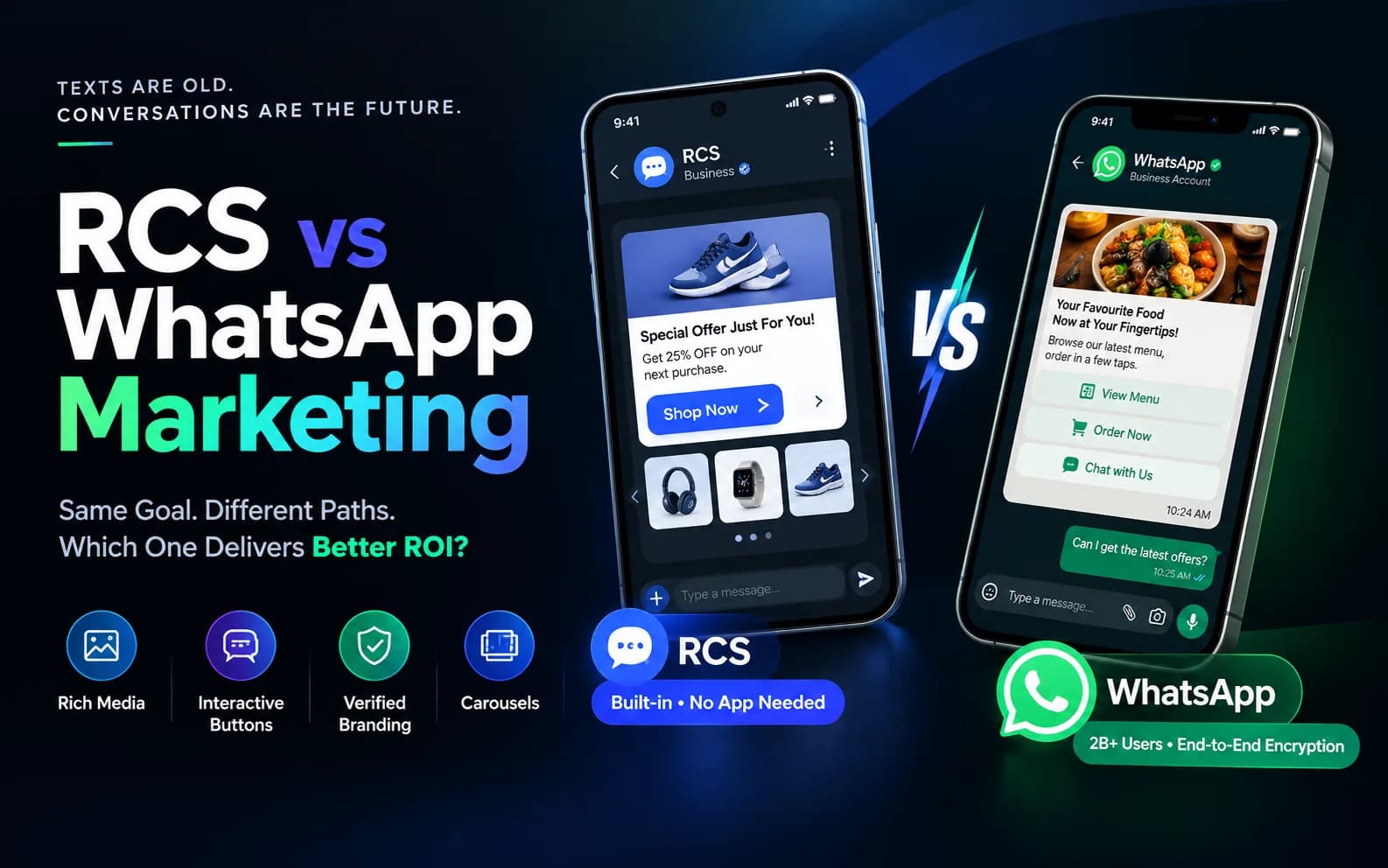
RCS vs WhatsApp Marketing: Which Messaging Channel Should Your Business Choose?
Discover the key differences between RCS and WhatsApp marketing. Learn which rich messaging platform offers better engagement, ROI, and reach for your business growth.
