WhatsApp & Conversational Marketing · WhatsApp Business · 5 October 2026 · Harender Chaudhary · ~6 min read
Is WhatsApp Business No Longer Free? The New Meta Update Every Brand Needs to Know
Meta has officially rolled out major structural updates to its WhatsApp Business API pricing-introducing paid service messages, token-based AI rates, and standardized utility rules.
View WhatsApp Business product →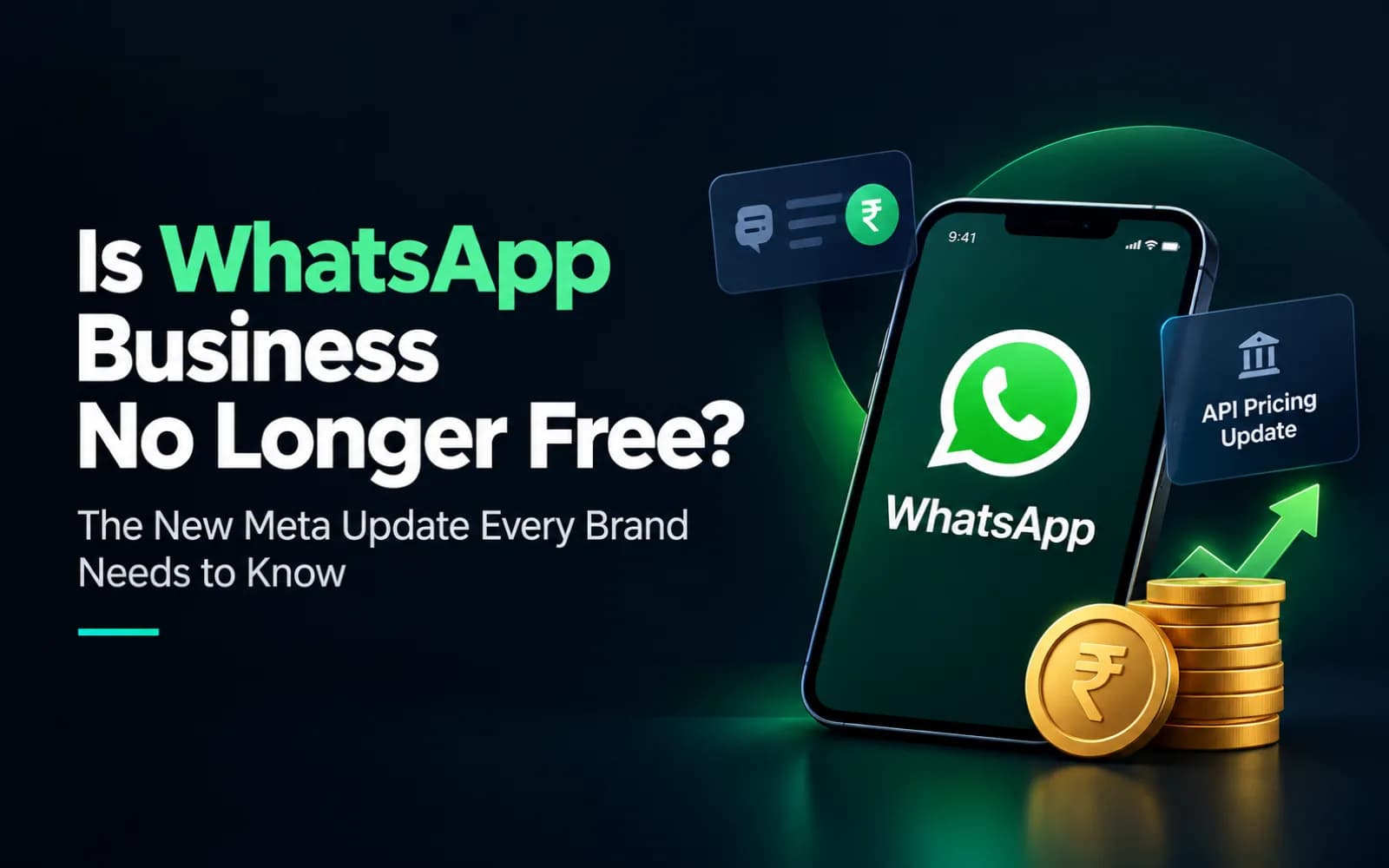
If your marketing or support stack relies heavily on WhatsApp, you’ve likely felt a quiet tremor across the CPaaS landscape. Meta has officially rolled out major structural updates to its WhatsApp Business API pricing model- introducing per-message charges on customer service chats, token-based consumption for AI agents, and stricter categorization rules for transactional updates.
For growth marketers, CX heads, and ops leaders in India, this triggers an immediate question: Is WhatsApp Business no longer free, and how significantly will this impact operational budgets?
The short answer: The free WhatsApp Business app on your phone remains free, but enterprise-grade WhatsApp API workflows are undergoing a major financial shift.
In this deep dive, we break down what Meta changed, analyze the unit economics, and reveal how modern omnichannel platforms like Azmarq help enterprises insulate their bottom line while continuing to deliver hyper-personalized conversational experiences.
1. What Exactly Changed in Meta’s WhatsApp Business Pricing?
For years, the rule of thumb for WhatsApp API was simple- User-initiated chats inside the 24-hour service window were free of per-message Meta conversation charges. You only paid for business-initiated templates (marketing, utility, authentication).
Meta’s updated framework fundamentally changes this dynamic:
- Paid Service Messages: Free-form support replies sent by agents or automated flows inside the 24-hour window are now charged on a per-message delivery basis once you cross a free monthly threshold.
- 1,000 Free Service Conversations Monthly: Every WhatsApp Business Account (WABA) gets a baseline allowance of 1,000 free service conversations per month. The 1,001st message triggers standard per-delivered-message rates (typically ranging between ₹0.115 to ₹0.145 per message in India).
- Token-Based Pricing for Meta AI Agents: Conversations handled via native Meta AI deployments now incur a token-based usage fee tied directly to model consumption and query complexity, rather than flat chat rates.
- Strict Utility Window Segmentation: Triggering Utility templates (like order receipts or tracking IDs) inside an active service session no longer "piggybacks" for free- they are billed consistently under the Utility category.

2. API vs. Regular App: Who Actually Gets Billed?
Before panic sets in across your local vendor ecosystem, it is vital to draw a line between the two ways WhatsApp operates for business:
- WhatsApp Business App (The Mobile App): Downloaded from the Google Play Store or Apple App Store. Used by individual shopkeepers, local consultants, and small teams. This remains 100% free. Meta is not charging for standard mobile app usage.
- WhatsApp Business Platform / API: Used by growing brands, D2C companies, BFSI institutions, and enterprise contact centers that integrate WhatsApp with CRMs, multi-agent inboxes, automated customer journeys, and AI engines. This is where the new pricing model strictly applies.
If you run high-volume Click-to-WhatsApp (CTWA) ads, deploy automated chat flows, or staff a live agent team, your monthly Meta bill will reflect these structural revisions.
3. The Operational Impact: Why Unchecked Automation Will Cost You
Under the old rules, long, rambling support threads costs your brand nothing in Meta fees- you only paid for agent bandwidth. Under the new model, inefficient chat loops directly burn capital.
Consider these realistic operational scenarios:
- The Infinite Bot Loop: An unoptimized chatbot that takes 8 back-and-forth messages to gather a customer's order ID now incurs per-message costs on every single interaction past your 1,000 free monthly quota.
- Unsegmented Live Chat: Answering simple questions ("Where is my store located?") via live human support on WhatsApp consumes paid service slots that could have been deflected elsewhere.
- Over-Messaging in Journeys: Blasting redundant conversational prompts without checking if the customer already opened an SMS or Email leads to budget leaks.
To keep CAC (Customer Acquisition Cost) and CTS (Cost-to-Serve) predictable, brands can no longer treat WhatsApp as an isolated, infinite messaging playground. It must be managed inside a unified CPaaS strategy.
4. Deep Analysis: How Azmarq Insulates Brands from Meta’s Price Hikes
At Azmarq, we built our omnichannel CPaaS architecture with real-world Indian operational realities in mind, where deliverability, DLT compliance, guardrails, and unit economics matter just as much as rich user experiences.
Instead of forcing you to absorb higher WhatsApp bills or cut back on customer engagement, Azmarq CPaaS provides the exact tools required to optimize every conversation:
A. Guarded AI Handoff via AI Agent Studio
Rather than relying on unconstrained, token-heavy AI models that continuously inflate your API charges, Azmarq AI Agent Studio operates with strict guardrails. It qualifies Click-to-WhatsApp (CTWA) leads, resolves routine first-mile FAQs in 1- 2 crisp turns, and instantly escalates complex queries into Azmarq Unified Inbox. By reducing chat length, you drastically trim per-message charges while keeping customer satisfaction high.
B. Smart Cross-Channel Fallbacks in Customer Journeys
Why pay for a WhatsApp service session when an automated SMS OTP or an RCS card gets the job done at a fraction of the price? With Azmarq Customer Journeys, you can design visual, multi-step orchestration on a single canvas:
- Start with a WhatsApp greeting.
- If a user doesn't respond or if a service window closes, automatically fallback to DLT-aware SMS or Email.
- Use Voice 360 OBD callbacks for high-stakes reminders (e.g., EMI collections or appointment confirmations) instead of dragging out a text thread.
C. Zero-Redundancy Profiling with My CDP
Multiple agents asking for the same customer details drains money. Azmarq My CDP acts as your central identity truth- storing contact attributes, past ticket history, order status, and consent flags across WhatsApp, Voice, SMS, and Email. When a user chats in, the agent or bot instantly reads their profile, eliminating useless back-and-forth message turns.
D. Multi-Agent Efficiency with Unified Inbox
Equipped with SLA tracking, automated routing queues, and ticket management, Azmarq Unified Inbox ensures live support agents resolve queries fast. Faster resolutions mean fewer total messages sent per customer ticket—directly capping your monthly Meta service message expenditure.
5. Strategic Checklist: 4 Steps to Protect Your WhatsApp ROI Today
If your business relies on WhatsApp API for sales or support, execute this 4-step framework immediately:
- Audit Your Average Message Count Per Resolution: Check how many messages your agents or bots exchange to resolve a single ticket. If it’s over 4 messages, your workflow needs streamlining.
- Deploy First-Mile AI Qualification: Use Azmarq AI Agent Studio to collect customer details upfront before a live human session opens.
- Set Up Omnichannel Fallbacks: Don't rely 100% on WhatsApp for every minor update. Route transactional receipts to Email/SMS and save WhatsApp for high-intent, high-ROI conversations.
- Unify Your Customer Data: Eliminate context-free messaging by plugging your CTWA ad traffic and chat threads directly into My CDP.
The Verdict: Meta’s Update Rewards Smarter Orchestration
Meta’s new pricing model isn't the end of WhatsApp marketing- it’s simply the end of unmonitored, bloated messaging workflows.
Brands that continue relying on single-channel, fragmented tools will see their operating bills surge. However, organizations that leverage a unified, omnichannel platform like Azmarq will convert these pricing changes into a competitive advantage- delivering faster resolutions, cleaner cross-channel journeys, and maximum ROI on every customer conversation.
Ready to optimize your WhatsApp API costs while scaling your customer CX?
👉Explore Azmarq CPaaS or Book a Demo with Our CX Experts Today.
Written by

Harender Chaudhary
CPaaS Content Strategist at Azmarq
Harender Choudhary is a digital marketing and customer communication strategist with extensive experience in SEO, performance marketing, digital growth, and technology-led customer engagement. His areas of expertise include CPaaS, WhatsApp Business, conversational communication, SMS, RCS, automation, and omnichannel customer engagement. He focuses on simplifying complex digital communication technologies and exploring how businesses can use automation, messaging platforms, and data-driven marketing strategies to improve customer engagement, generate leads, and drive sustainable business growth.
Frequently asked questions
Q1. Will my small business WhatsApp app on my Android/iPhone start charging me?
No. The standard WhatsApp Business app downloaded from the app stores remains completely free for small businesses and local shopkeepers. Meta’s updated pricing applies exclusively to the WhatsApp Business Platform / API used for automated, high-volume enterprise messaging.
Q2. How many free messages do we get on WhatsApp API every month?
Meta provides 1,000 free service conversations per month per WhatsApp Business Account (WABA). Once your business crosses 1,000 service messages in a given month, additional service messages are charged at regional per-message rates.
Q3. What is the difference between a Service Message and a Utility Message on WhatsApp?
Service Messages are user-initiated customer support conversations (e.g., a customer asking "How do I return my order?"). Utility Messages are business-initiated updates regarding an ongoing transaction (e.g., order confirmations, shipping updates, or 2FA OTP codes).
Q4. Can we reduce our Meta WhatsApp API costs without stopping customer chats?
Yes. By managing your messaging through Azmarq CPaaS, you can deflect simple queries using AI Agent Studio, route lightweight transactional alerts to lower-cost channels like SMS or Email via Customer Journeys, and use Unified Inbox to resolve tickets in fewer back-and-forth turns.
Q5. How does Azmarq help businesses handle CTWA (Click-to-WhatsApp) ads cost-effectively?
Azmarq captures CTWA leads instantly into My CDP, qualifies them automatically using guardrailed AI agents, and assigns high-intent leads to sales agents in Unified Inbox, ensuring ad spend translates into fast conversions before incurring unnecessary chat charges.
Related articles
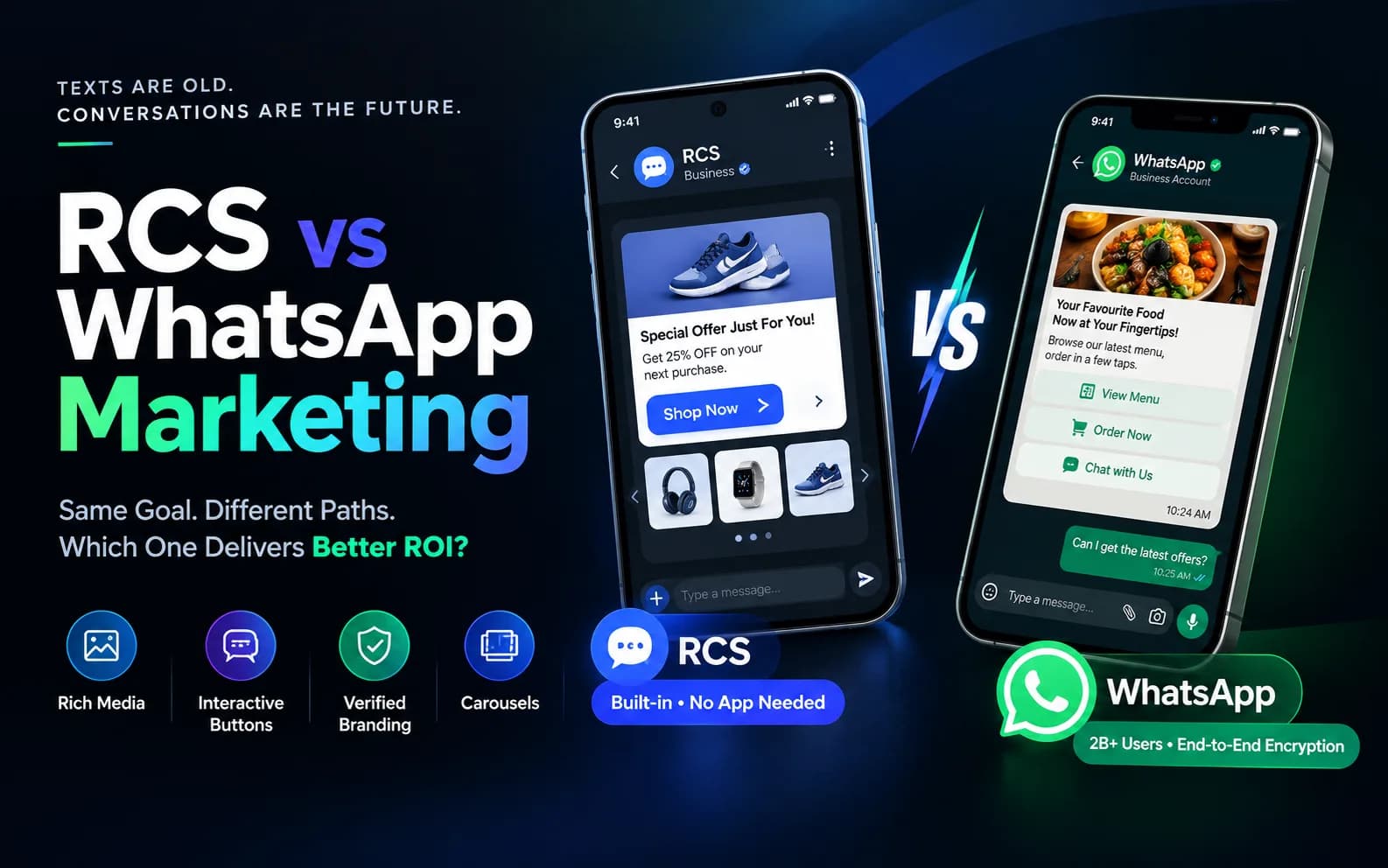
RCS vs WhatsApp Marketing: Which Messaging Channel Should Your Business Choose?
Discover the key differences between RCS and WhatsApp marketing. Learn which rich messaging platform offers better engagement, ROI, and reach for your business growth.
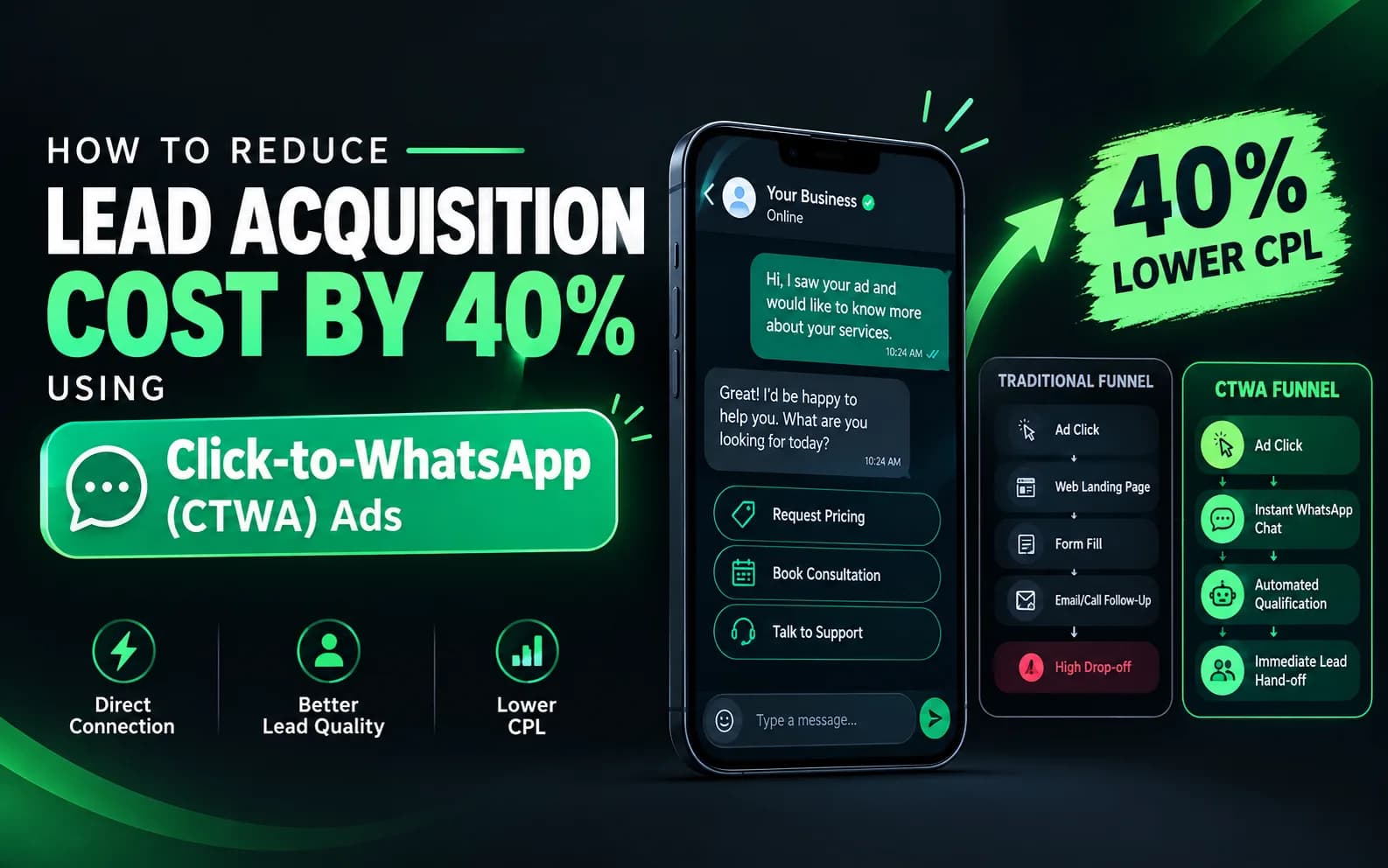
How to Reduce Lead Acquisition Cost by 40% Using Click-to-WhatsApp (CTWA) Ads
Tired of high ad spend and poor landing page conversions? Discover how switching to Click-to-WhatsApp (CTWA) Ads removes drop-off friction, qualifies leads automatically, and slashes your overall lead acquisition costs by up to 40%.
How to Scale Lead Generation with Click-to-WhatsApp (CTWA) Ads: A Complete 2026 Blueprint
A complete 2026 guide to running high-converting Click-to-WhatsApp Ads. Learn step-by-step setup, qualification chatflows, and Meta CAPI integration.
